Curriculum Statement
At East Boldon Infants we believe music is a practical, creative subject which can benefit all children in developing imagination, the ability to listen attentively and the ability to express personal thoughts and feelings. Music is a powerful, unique form of communication and can change the way people feel, think and act. It brings together intellect and feeling and enables personal expression, reflection and emotional development. Music is an integral part of most world cultures, past and present. Music encourages active involvement and demands a response. It allows for creativity and aesthetic sensitivity and fulfilment.
Through our Music curriculum we aim:
- We aim to deliver a broad and balanced music curriculum which:
- They will understand and explore how music is created, produced and communicated, including through the inter-related dimensions: pitch, duration, dynamics, tempo, timbre, texture, structure and appropriate musical notations.
- Enables pupils to perform, listen to, review and evaluate music across a range of historical periods, genres and gaining knowledge of the works of great composers and musicians.
- Our pupils will learn to sing and use their voices.
- They will create and compose music on their own and alongside their peers.
Curriculum Intent
In KS1, our pupils have weekly music lessons. Skills are taught in order, developing throughout the year groups, and are revisited and embedded throughout every year group; each term’s lessons work through each of the key musical concepts.
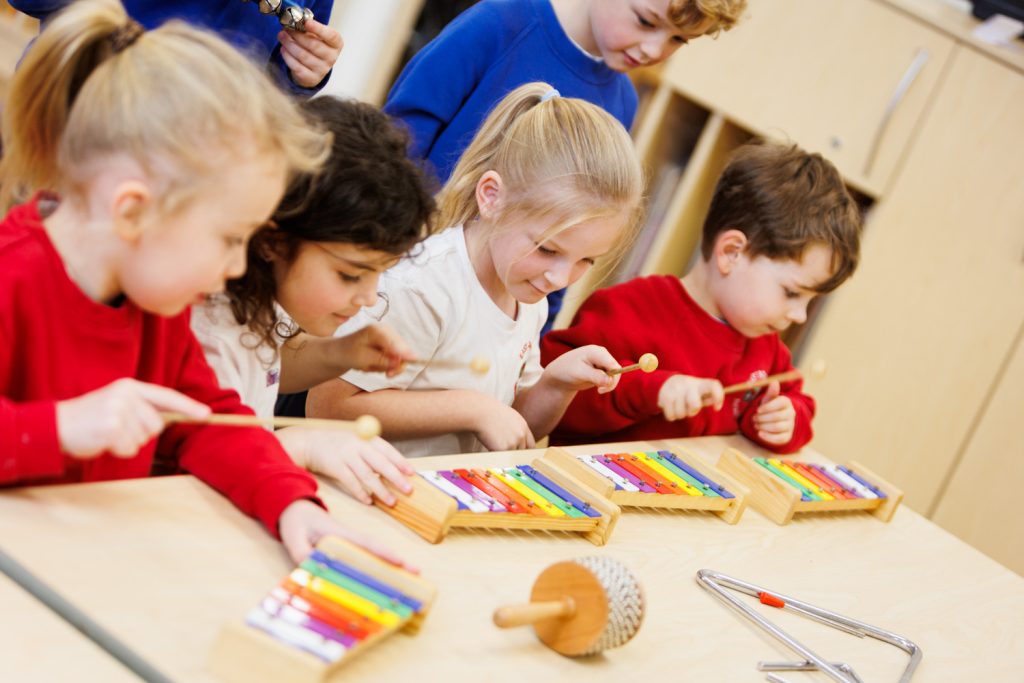
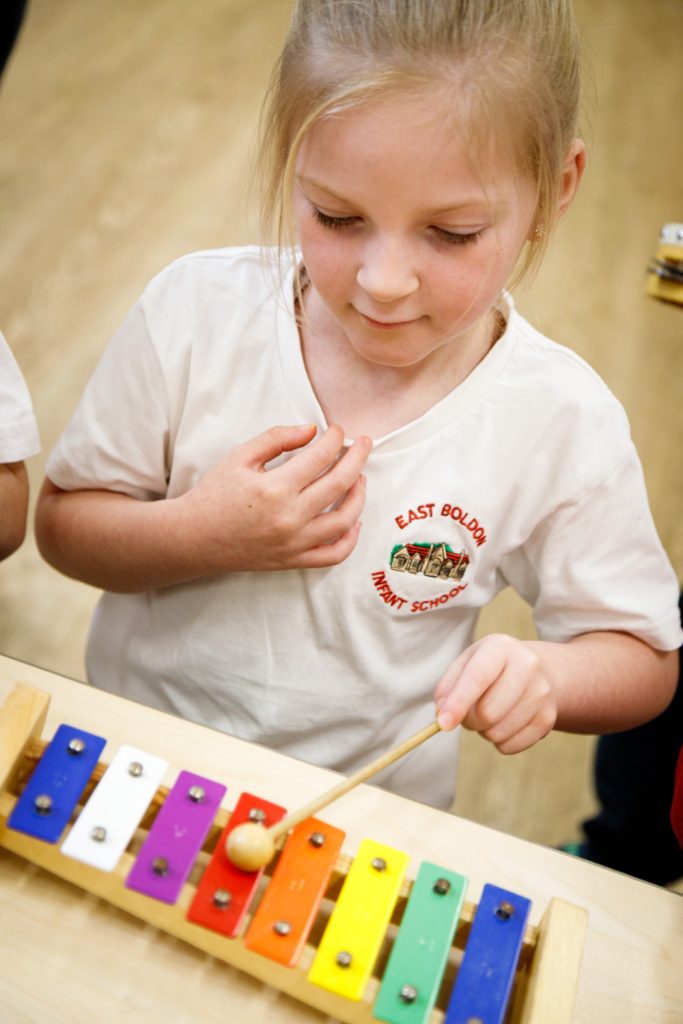
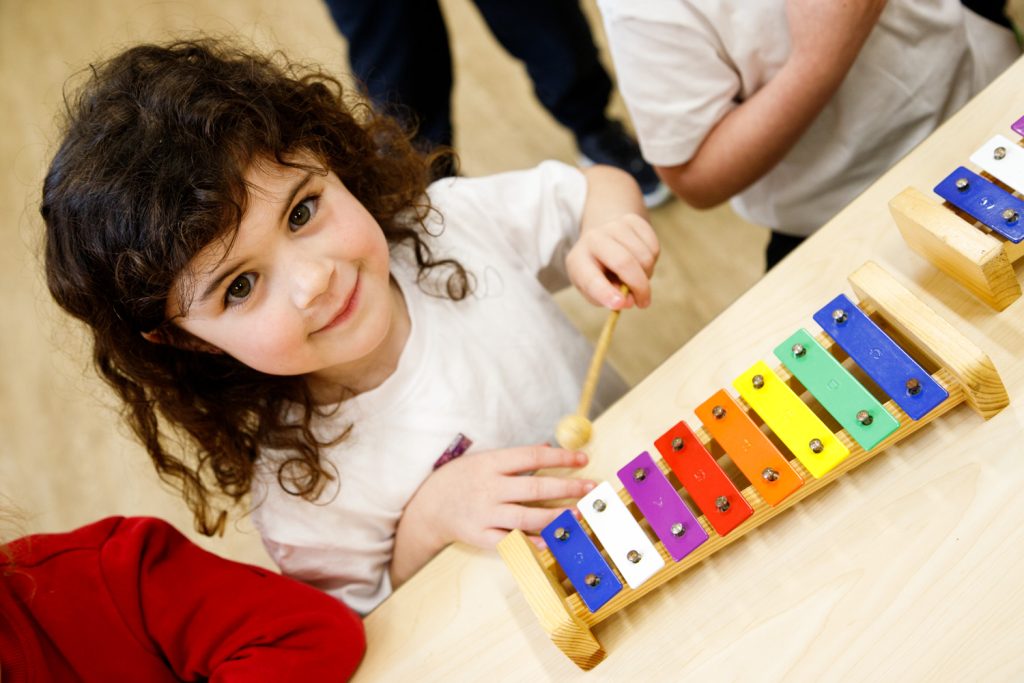
In KS1, we use the ‘Charanga’ scheme of work which incorporates all components of the Model Music Curriculum and meets all the requirements of the National Curriculum. Through our ‘Charanga’ scheme of work, musical skills are introduced, revisited and embedded to enhance the ability of all our pupils. Pupils understand musical concepts through a repetition-based approach to learning. Learning about the same musical concept through different musical activities enables a more secure, deeper learning and mastery of musical skills. Our pupils have the opportunity to both develop new musical skills and concepts, and re-visit established musical skills and concepts. They learn key vocabulary and develop their skills using tuned and un-tuned instruments.
Through our music curriculum, pupils are provided with the opportunity to become actively involved in music through a balance of listening, appraising, composing and performing. Progression and continuity through the school are ensured through a structured music curriculum which provides the pupils with a wide range of opportunities for them to develop this range of skills. It comprises of the following aspects:
Singing
In Year 1, pupils will be taught to sing simple songs, chants and rhymes from memory, sing collectively and at the same pitch, responding to simple visual directions and counting in. They will sing a wide range of call and response songs to control vocal pitch and to match the pitch they hear with accuracy. In Year 2, pupils will be taught to sing songs regularly with increasing vocal control. They will sing songs with a small pitch range, accurately. Pupils will be taught the meaning of dynamics and demonstrate these when singing.
Listening
Pupils will listen to and appraise a wide variety of musical styles and genres from the past up to the present day. Pupils will be taught to recognise changes in tempo and respond to these through movement and be able to maintain a steady pulse, identifying the strongest beat.
Composing
Pupils will be taught to improvise simple vocal chants and create music in response to stimuli, choosing the most appropriate instruments. They will be taught the difference between creating a rhythm pattern and a pitch pattern and compose their own. Graphic notation will be introduced to represent sounds and pupils will be encouraged to develop their own symbols.
Performing
Pupils will continue to develop their skills on tuned instruments and play and perform using simple notation.
We recognise that there are children of widely different musical abilities in all classes, so we provide suitable learning opportunities for all children by matching the challenge of the task to the ability of the child. We achieve this in a variety of ways by:
- Setting common tasks which are open-ended and can have a variety of responses.
- Setting tasks of increasing difficulty (not all children complete all tasks).
- Providing resources of different complexity depending on the ability of the child.
In the Early Years Foundation Stage (EYFS), pupils begin their journey in music through the specific area of Expressive Arts and Design. They are encouraged to be imaginative and to explore different media and movement to express themselves.
Within the EYFS setting, music is an integral part of pupils’ learning journey. Pupils sing regularly, learning a wide range of songs and rhymes. They begin to build a repertoire of songs and imitate movements in response to the music they hear. Pupils learn rhythm, rhyme, pulse and pitch by experimenting with their voice. They are supported to develop the confidence to perform music and are exposed to a wide range of musical instruments. Pupils use different instruments to experiment and explore the different sounds made.
Music lessons take place both inside and outside the classroom, exploring the environment and creating new sounds using musical instruments and everyday objects. Oral rehearsing of songs including familiar nursery rhymes, number songs and stories are practised daily.
Fundamental skills are developed within the EYFS and as pupils progress through our school, their skillset is fine-tuned to provide them with strong foundations for their future musical lives.
Curriculum Implementation
Teachers create a positive attitude to science learning within their classrooms and reinforce an expectation that all children are capable of achieving high standards in science. Our whole school approach to the teaching and learning of science involves the following;
The Early Years curriculum is based around the Seven Areas of Learning set out in the EYFS. There is scientific content within the learning area Understanding the World, which is practical and often play-based.
Science in the reception classes is taught as an integral part of the topic work covered during the year. Each topic starts with a Prime Learning Challenge which is expressed as a question, for example; ‘What do seeds need to grow?’ Observation of children’s interests and activities also informs planning and provision for this area of learning.
Scientific learning occurs through:
- Access to a range of developmentally appropriate practical activities based on first hand exploratory experiences. For example, a nature walk, magnifiers to explore natural objects, manipulating wet/dry sand etc;
- Enthusiastic and meaningful interaction with adults, who provide opportunities to develop communication skills, use correct scientific language and carefully framed open-ended questioning techniques to develop thinking skills;
- Exploration of both indoor and outdoor environments linking all areas of learning;
- Recognition and extension of their existing knowledge and understanding gained from their home setting.
Children are encouraged to –
- Be active learners and involved in a range of physical experiences, which allow them to take charge of situations.
- Take the initiative in developing their own ideas and approaches to an activity.
- Be involved in talk between themselves as well as adults.
- Build their confidence not only in science, but also in the management of their own activity and involvement with others.
- Develop as emergent thinkers not only in science, but also in Mathematics and Communication and Language.
The science based activities in reception provide the foundation for progressing to the scientific concepts covered in Year 1 and Year 2.
In Key Stage 1 the science curriculum is planned through the use of thematic topics which are outlined in the scheme of work.
As part of our Learning Challenge Curriculum, each topic starts with a Prime Learning Challenge which is expressed as a question. All year groups have a breakdown of knowledge, skills and understanding to be taught for each subject and this ensures that progression is built upon from the previous year’s learning so that there is an increasing challenge for the children as they move through the school. We start all new learning challenges with a pre- learning task to assess children’s prior knowledge before planning any subsidiary learning tasks. This also ensures that any gaps in learning can be addressed. The subsidiary learning tasks are also expressed as questions
A variety of teaching methods and stimuli will be employed to enable us to achieve our aims and objectives. They will be matched to the abilities and interests of the children and will include:
- Whole class teaching
- Group activities
- Individual/partner work
- An investigation area/seasonal display set up in each classroom
- Plenary sessions (reporting back)
- Using materials from other science schemes of work as appropriate
There is no specialist teaching in science, it is taught by the class teachers in all year groups.
We follow the National Curriculum programme of study for science, accessing activities from other published schemes as and when appropriate.
Activities are challenging, motivating and extend pupils’ learning. Lessons make effective links with other curriculum areas, especially English, Mathematics and ICT.
Activities inspire the pupils to experiment and investigate the world around them and to participate in a range of activities. These include:
- asking questions;
- locating sources of information;
- observation and discussion;
- selecting appropriate equipment and using it safely;
- planning investigative work;
- investigation;
- raising ideas and prediction;
- testing;
- handling and collecting evidence, measuring and checking results;
- making comparisons;
- describing patterns;
- communicating results and findings.
Curriculum Impact
Ongoing assessments take place throughout the year. Teachers use this information to inform future lessons; ensuring children are supported and challenged appropriately. This data is analysed on a termly basis by the Subject Lead for Music to inform and address any trends or gaps in attainment.
Children in Foundation Stage are assessed within Expressive Arts and Design and their progress is tracked termly using the Evidence Me tracker system. Age related expectation levels are reported to parents at the end of the reception year.
Across Music staff will look at ways that the curriculum can be enhanced further. This may take the form of visits to the school by artists or craftspeople, or a visit out of school perhaps to a gallery in order to support pupil’s learning in art.
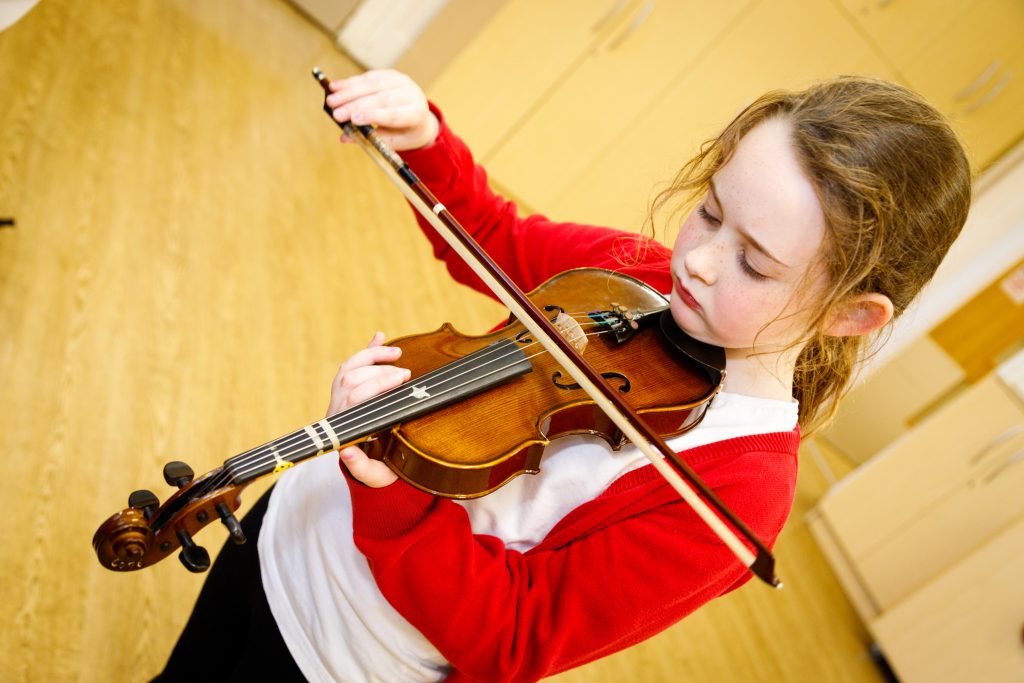
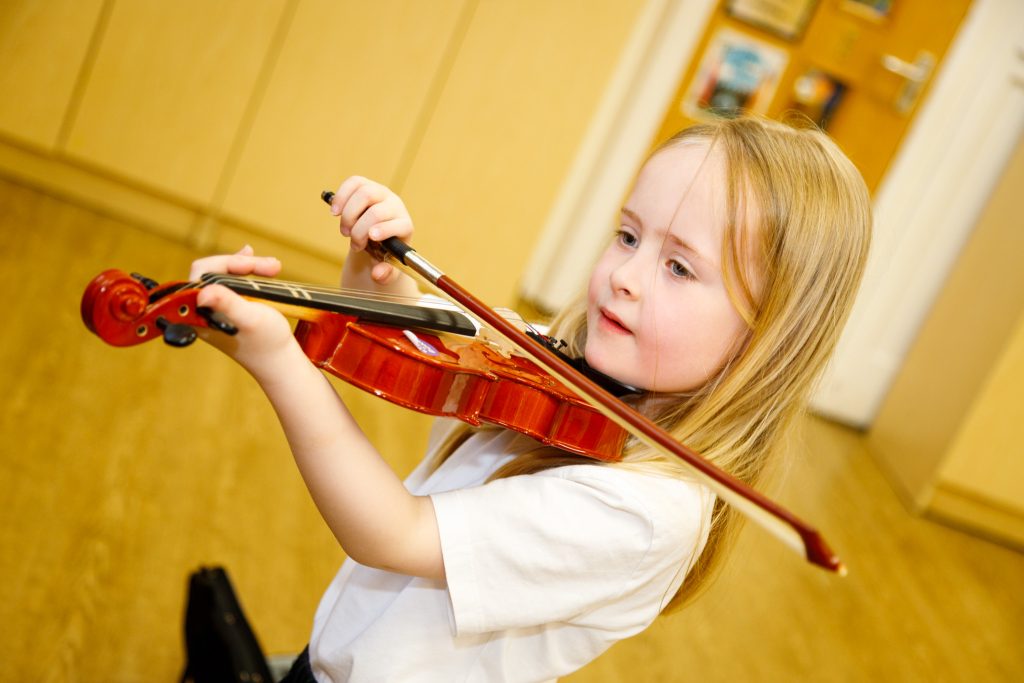
We often use Music Clubs as an After School provision to enrich the school curriculum further and are currently working with Music Mates to provide violin and cello tuition in school.
Teachers will assess children’s work in Music by making informal judgements through observations during lessons. On completion of a piece of work, the teacher assesses it, and uses this assessment to plan for future learning. Written or verbal feedback is given to the child to help guide his/her progress.
Children are assessed at the end of each strand of work to determine progress against expected levels of achievement. We have sufficient resources for all Music teaching strands in school. We keep these in a central trolley.
Evidence Me may be used to evidence practical elements of the Music curriculum
Wider opportunities:
Singing Assemblies
In addition to music lessons, we incorporate music in many areas of the curriculum. Pupils from Reception to Year 2 participate in weekly singing assemblies where they learn and sing new songs together as well as develop new singing techniques. We explore a new composer every week and enjoy listening to their music. In addition, pupils listen to a different piece of music in every assembly.
Performances
We provide opportunities for the pupils to perform in front of an audience throughout their time with us.
Pupils are given the opportunity to perform music in a range of contexts. Religious festivals, cultural festivals and assemblies are celebrated with music.
Reception – Christmas nativity and Spring performance
Year 1 – Christmas nativity and harvest festival
Year 2 – Christmas show and leavers assembly
Our performances provide pupils with the exciting opportunity to learn new songs, dances and perform. These performances are the highlight of our year and the pupils have so much fun rehearsing and putting on a show!
Musicians
Musicians have visited our school and performed for the children. This has provided our pupils with lots of interesting information about the instruments the musicians play. We have enjoyed an African drumming workshop, a Bollywood singer and dancer and a guitar player.
Music Mark Award
We are delighted to announce that we have been awarded the Music Mark Award in recognition of our school’s commitment to music education. Music Mark is the UK Association for music education, championing and supporting access to music for all children and young people. It works to support and enable our school to deliver high-quality musical and social outcomes for all children.
Music makers club:
In Music club we provide an opportunity for children to explore music outside of their standard curriculum. We enjoy experimenting with new instruments, making instruments and composing our own music using exciting technology!
Small group tuition:
We currently offer small group tuition in KS1 for the following instruments:
- Guitar
- Ukulele
- Violin
All children experience a taster lesson of these instruments and have the opportunity to develop their skills further in small group tuition.
Festivals:
At East Boldon Infant School we take part in the following each year to promote a love for music and performing arts:
- South Tyneside schools dance festival
- The mini sing at The Glasshouse
Monitoring of music will be carried out in line with our monitoring programme for school. Monitoring will include:
- Lesson observations
- Scrutiny of children’s work and planning
- Tracking of pupil progress
- Use of Assessment Data
- Discussions with pupils – Pupil Voice
- Discussions with staff – Staff Voice
- Monitoring of subject development plans by subject leads
- Link governor visits
Monitoring will in particular include focus on:
- Specific areas linked to the School Improvement Plan
- The lowest 20% of children
- The Pupil Premium children
- The SEND children
- Effective challenge
- Timely adapting to the needs of the children
- Effective use of resources
- Engagement and focus of the children